MODCHQ - SET UP AND MAINTENANCE
Ó UNCTAD – SITE (V1.15)
10.21
Agreements
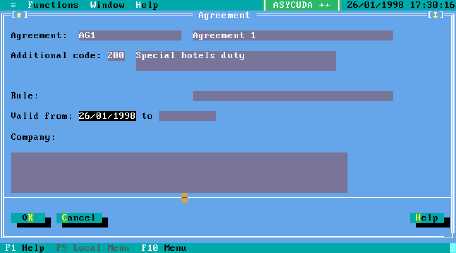
In the Agreement table you can list Companies and Commodities, which are to receive special
taxation treatment. This special treatment is normally some form of relief. The syntax used for the
Commodities is as described in Section 9 of this Reference Document under ‘Simplified
management of the Tariff’, ‘Defining the Tariff Range’.
Fig. 10.15 MODCHQ : Functions: Database Management: Customs Procedure Code:
Agreement
Agreements can be used in two different ways to achieve different types of relief.
·
General - If the relief is available to certain Companies irrespective of the CPC they are
declaring their goods under, then an appropriate rule can be inserted in the ‘Agreement’ to
cause the relief to be granted.
·
Specific - If a relief under an ‘Additional Code’ is limited to certain Companies or Commodities
then the Agreement record is set up differently. No rule is included in the Agreement but the
Agreement itself is linked to the Additional Code that contains the rule giving the relief.
The additional code record has a box that holds Agreement ‘Yes’/’No’. The agreement record has
a box to insert the name of the appropriate ‘Additional Code’. Only if the importer requests the relief
by declaring the ‘Additional Code’ does the system check that the importer/goods are eligible for
that relief. If they are not then the system will not accept the ‘Additional Code’ declared and gives
an error message that the company/commodity are not authorised to receive the relief.
An example of this would be a VAT relief that is available only to registered
Companies. If a rule exempting VAT were inserted in to the Agreement then no
matter which Procedure code was used, a Company included in the Agreement
would be relieved of VAT. This is because no link to procedures is defined and
the system checks the Agreement table for all declarations to check if the
importer is eligible for some sort of relief.