TAXATION MANAGEMENT USING ASYCUDA++
Ó UNCTAD - SITE (V1.15)
A.13
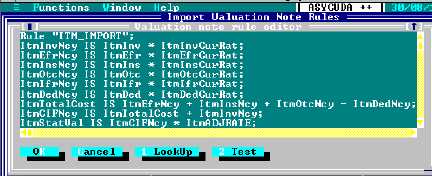
Line 1 is the Keyword ‘Rule’ and Rule name: "SG_IMPORT" and Lines 2 to 7 take declaration
data:
Inv
Invoice amount in Foreign currency
Efr
External freight amount in Foreign currency
Ins
Insurance amount in Foreign currency
Otc
Other cost amount in Foreign currency
Ifr
Internal freight amount in Foreign currency
Ded
Deductions amount in Foreign currency
..and multiplies by the currency conversion rates:
InvCurRat
Invoice Currency Exchange Rate
EfrCurRat
External freight Currency Exchange Rate
InsCurRat
Insurance Currency Exchange Rate
OtcCurRat
Other cost Currency Exchange Rate
IfrCurRat
Internal freight Currency Exchange Rate
DedCurRat
Deductions Currency Exchange Rate
... to give an amount in National Currency, represented by the variables:
InvNcy
Invoice amount in National Currency
EfrNcy
External freight amount in National Currency
InsNcy
Insurance amount in National Currency
OtcNcy
Other cost amount in National Currency
IfrNcy
Internal freight amount in National Currency
DedNcy
Deductions amount in National Currency
DedCur
Deductions currency code
The variable TotalCost is used to store the value of freight, insurance, other charges, less
deductions, after conversion to the National Currency. Invoice amount and total other costs
(InvNcy + Total Cost) are added and stored to CIFNcy (CIF value in National Currency).
Item Section
The purpose of the 'Item Section' Valuation Note Rule is to calculate, using declaration data and
reference tables, the invoice amounts, freight, insurance, other charges and deductions at the
declaration item level. Amounts input from the declaration are converted to national currency,
added, and the Customs value (taxbase) is stored to the variable called ItmStatVal.
Figure A.7: MODCHQCF: Functions: Import Valuation Note: Item Selection