MODCHQ - SET UP AND MAINTENANCE
Ó UNCTAD – SITE (V1.15)
10.24
The processing program captured is checked to see that the Customs Office Code, the
consignee/exporter and the ‘Action Code’ match and also that the date is within the range.
Two reports are available in MODCBR to give lists of all the products or all the declarations for one
processing program. These reports can be accessed from the following options:
·
MODCBR ‘Functions’, ‘Suspense procedures’, ‘Customs processing’, ‘Product’ and
·
MODCBR ‘Functions’, ‘Suspense procedures’, ‘Customs processing’, ‘Declaration’.
Transport
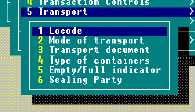
These tables contain codes and descriptions commonly used within the Customs declaration and
with Manifest controls – the Manifest and Bills of Lading.
‘Locode’ is an international standard location code. Usually 5 alpha characters, the ‘Locode’ is
made up from the country code (2 characters) and the port code (of 3 characters). The screen for
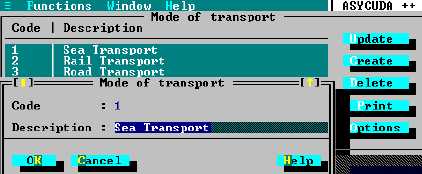
‘Mode of Transport’ is shown as an example.
As with all codes, apart from country specific codes like those under the
operational environment sub-menu, the standards set out in the United Nations
Trade Data Elements Directory should be adhered to.
Fig. 10.18 MODCHQ : Functions: Database Management: Transport: Mode of Transport
International Trade Terms
These tables contain codes and descriptions covering commonly used trading and commercial
terms. Some are used to describe the commercial relationship between a buyer and seller in a
transaction, and so are used to help in establishing the Customs valuation of goods.
The tables cover:
1.
Terms of delivery
2.
Package code
3.
Nature of transaction
4.
Terms of payment
5.
Means of payment
Fig. 10.17
MODCHQ : Functions:
Database Management: Transport: