MODCHQ - SET UP AND MAINTENANCE
Ó UNCTAD – SITE (V1.15)
10.28
ASY++ Gate
The ASY++ Gate provides the mechanism by which a National system can function. It allows for
the transfer of master files and information from Headquarters to all ASYCUDA offices and the
return of statistical information to Headquarters.
The ASYCUDA National Transit system relies on the ASY++ Gate for the passing of messages
between offices to control the dispatch and receipt of goods in internal transit. Messages are
prepared and received from within ASYCUDA++ modules MODTRS and MODBRK and passed
via the ASY++ Gate. See Section 7of this Reference Document.
Effective use of the ASY++ Gate and MODGTW provides an extremely powerful tool within the
ASYCUDA++ system.
Testing Declaration Processes
In building ASYCUDA++ or testing functions on your trial or development system, you will often
have a need to process a batch of test declarations to create a bank of test data from processed
transactions. One example could be to have a transaction database against which to test statistical
data extractions. You can process test declarations one by one, using the normal creation process,
or you can use a macro to partly automate the declaration creation. A quicker method is to use
ASYCUDA’s test utility – Module MODTST.
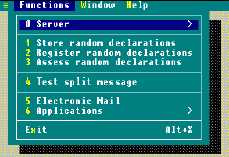
This module allows you to ‘Store’, ‘Register’ or ‘Assess’ a batch of randomly prepared declarations.
When opening a menu option you are prompted to enter a number for the total of random
declarations that you wish to process.
Note that the test process works by picking up the first stored declaration within
the ASY/SAD subdirectory of your client machine. The program uses that
declaration as the starting point, and then selects, at random from the reference
tables, data elements such as company, broker, country, currency and tariff
codes for each subsequent declaration.
The uses and functioning of the ASY++ Gate is fully covered in the
Technical documentation that should be studied for a full understanding
of it’s potential.
Fig. 10. 22 ‘MODTST:Functions’